
You’re Not Interesting Enough
Why does contemporary cinema hate mediocrity?


In recent years, ordinary life has ceased to exist in cinema. Characters must be unique, broken, extreme, or at least “in the process.” A stable job, unspectacular relationships, and a lack of narrative breakthroughs are not a neutral state, but something suspicious, almost shameful. Cinema teaches us that if life is not intense, it means it has been lived badly. This is not an aesthetic coincidence - it is a cultural norm. Mediocrity is supplanted by narratives of self-realization, authenticity, and “being yourself,” which in practice mean the constant need to stand out. Even suffering must be spectacular, even failure - productive. Ordinariness generates no meaning, and so it ceases to be told. This means that mediocrity becomes a form of cultural invisibility. Quiet work, routine relationships, everyday stability - everything that was once neutral or valuable no longer fits into the narrative. Instead, the language of drama and extremity emerges: characters must experience suffering in spectacular ways, otherwise they cease to exist in the story. This shift in language is not only aesthetic but also ideological: it teaches us that the value of life is measured by drama, not ordinariness.
Contemporary cinema not only aestheticizes intensity, but establishes it as the norm. Emotional instability, constant searching for oneself, and visible transformation become proof that life is being lived “properly.” Calmness has no narrative value. Repetition leads nowhere. Persistence is not a story. The viewer learns to read their own biography in the same language: decisions must reveal something, stages of life must lead to change, and every moment should somehow justify itself.
That is why mediocrity ceases to be neutral. It begins to look like a lack - not of experience, but of intensity. Not of meaning, but of drama. Cinema does not offer a language for a life that is about sustaining rather than breaking through; about being “okay” rather than “in process.” If you don’t become someone else, you risk your life not being considered meaningful enough. So it is not only ordinary life that disappears, but also the possibility of living it without shame. In a culture that demands constant narrative visibility, ordinariness becomes a private embarrassment. Cinema does not so much describe this as train us in it: it teaches us to expect crisis, to distrust stability, and to interpret calm as a narrative failure. Life without spectacle is no longer simply life. It is something not worth telling. And increasingly, something that we don’t really know how to defend.
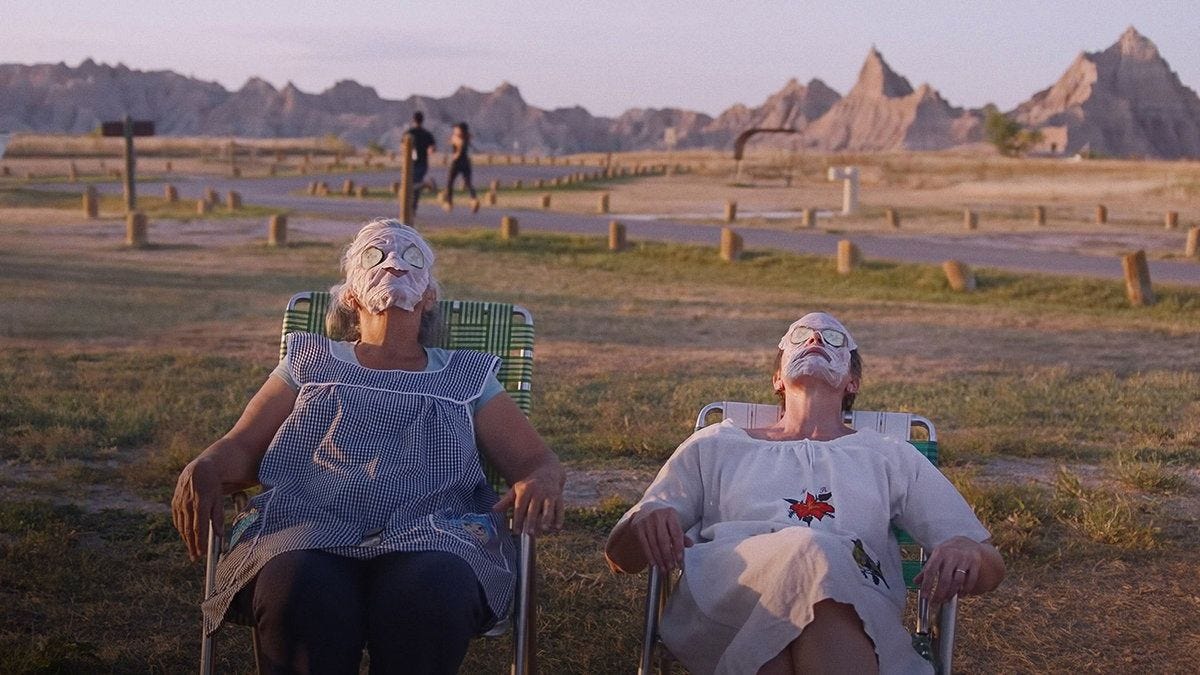
This diagnosis, however, becomes more precise if we locate the problem not in cinema as such, but in its dominant, mainstream form. Ordinary life has not disappeared entirely from film language; it has been structurally displaced into the field of independent cinema, which operates outside the imperative of narrative escalation and visible transformation. Films such as Nomadland (2020) or Aftersun (2022) are built precisely around what mainstream cinema treats as narratively insufficient: duration instead of breakthrough, affective undercurrents instead of dramatic events, and lives that do not culminate in becoming “someone else.” Here, meaning does not arise from intensity or crisis, but from persistence, repetition, and the quiet labour of staying with what is already there. The fact that such films circulate largely outside the mainstream -and are legitimised primarily through festival circuits rather than mass distribution - reveals that the issue is not the cultural impossibility of ordinariness, but its incompatibility with a dominant narrative economy that demands constant justification through drama. Ordinariness survives, but only in spaces that can afford narrative restraint; it is not absent, but marginalised, rendered visible only where cinema is freed from the obligation to prove that life must be exceptional in order to matter.
This whole essay brings a point that I always felt while watching movies but never fully expressed and I’m glad that you wrote about this! I find it a shame that movies don’t try to find the beauty in the ordinary. I find the best movie that has done this is Studio Ghibli’s Whisper of the Heart. It truly captures the beauty of the everyday life of a young girl who’s just going through elementary school and wants to be a writer. It’s not over the top or dramatic, it’s cute and simple (I wrote about it on here cuz I’m literally obsessed with it lol) and I wish there were more movies showcasing regular people’s lives like that!
Very interesting analysis